
Chiniot Furniture Market

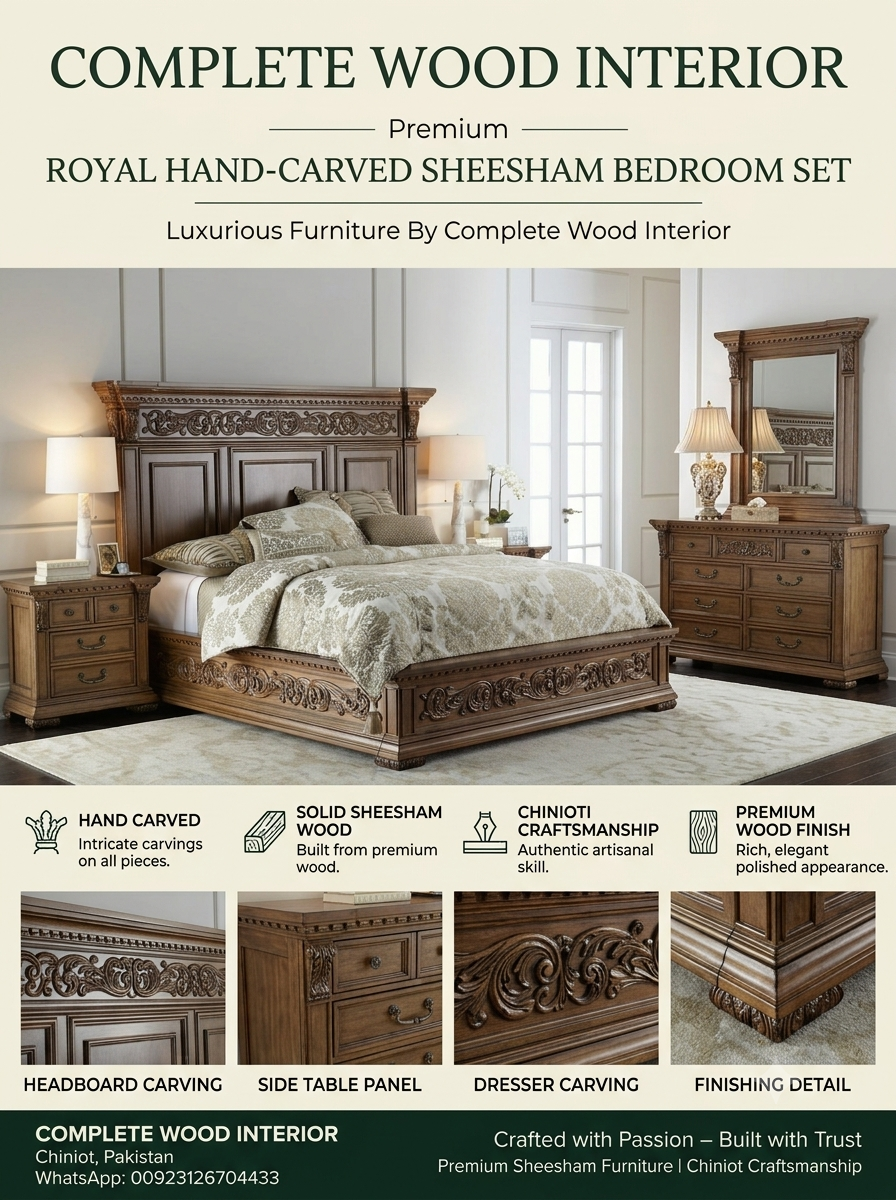
Chiniot Furniture Market: The Story of Chinioti Craftsmanship, History & Wooden Furniture
By Complete Wood Interior | Chiniot, Pakistan
When people in Pakistan talk about handcrafted wooden furniture, one name that naturally comes to mind is Chiniot.
Located on the banks of the River Chenab, Chiniot has developed a strong reputation for woodworking, carved furniture and traditional craftsmanship. Today, the city is home to a large furniture-making industry, where traditional skills continue alongside modern furniture designs. The official district profile lists 513 furniture units in Chiniot District.
But Chinioti furniture is more than a business.
It is a part of the city's cultural identity.
A Brief History of Chiniot
Chiniot is a historic city of Punjab situated beside the River Chenab. The exact origins of the city are not completely certain. The official district history notes that historical records do not provide a definitive account of its founding, although traditional accounts connect the city's earlier name, Chandaniot or Chandniot, with a figure named Chandan.
During the Mughal period, Chiniot was part of the Lahore province. The city became particularly important during the reign of Mughal Emperor Shah Jahan and under the governorship of Nawab Saadullah Khan, who served in the mid-17th century.
The city's historical architecture also reflects this period.
One of its well-known landmarks is the Shahi Mosque, associated with Nawab Saadullah Khan, while Chiniot's historic buildings demonstrate the city's long tradition of decorative craftsmanship.
How Chiniot Became Famous for Woodworking
One interesting part of Chiniot's furniture history is its connection with the River Chenab.
According to the official Chiniot district history, the city's woodworking industry developed partly because of its location near the Chenab, through which timber from Kashmir was historically transported toward the Chiniot region.
Over generations, local craftsmen developed skills in working with wood, creating furniture and architectural details featuring intricate decorative work.
The result was a distinctive tradition that became known as Chinioti craftsmanship.
What Makes Chinioti Furniture Different?
The most recognizable feature of traditional Chinioti furniture is often its detailed carving.
Craftsmen can transform an ordinary wooden surface into a decorative piece through carefully planned patterns, curves, floral elements and geometric details.
The National Register of the Intangible Cultural Heritage of Pakistan specifically identifies Chiniot and Swat as important centres of wood carving and describes Chinioti furniture as a significant traditional craft. It also notes that carved elements are commonly found on items such as table legs, beds and chests.
This craftsmanship requires patience.
A carved bed, for example, is not simply a piece of furniture. It may involve several different stages:
Wood selection → cutting → shaping → joining → carving → sanding → polishing → upholstery → final finishing
Every stage contributes to the final appearance.
Chinioti Furniture Market
Today, Chiniot has a well-established furniture industry with furniture shops, manufacturers, wholesalers and workshops operating across the city.
A number of furniture businesses are concentrated around areas described locally and on business listings as the main furniture market and Chinioti Road, showing the continuing importance of furniture trade to the city. Chiniot furniture market
The market includes furniture ranging from traditional carved pieces to contemporary bedroom, drawing-room and dining-room designs.
Customers can find:
- 🛏️ Bedroom sets
- 🛋️ Drawing-room sofas
- 🍽️ Dining tables and chairs
- 🪵 Carved beds
- 🪞 Dressing tables
- 🚪 Wardrobes and almari
- 🪑 Bedroom chairs
- ☕ Center tables and tea trolleys
- 📺 TV units
- 🏠 Custom-made furniture
This variety has allowed Chiniot's furniture industry to evolve while maintaining its connection with traditional woodworking.
From Traditional Chinioti Designs to Modern Furniture
Furniture design has changed significantly over the years.
Traditional Chinioti furniture often features rich carving and decorative details. Modern customers, however, may want a combination of traditional craftsmanship and contemporary styling.
Today, customers may ask for:
Traditional Chinioti carving + modern upholstery
or
Classic wooden structure + Turkish-inspired design
or
Traditional carving + modern bedroom interior
This has created a new generation of furniture designs that combine heritage with modern lifestyle requirements.
AI Is Creating Even More Furniture Design Ideas
There is another major change happening in the furniture industry today: Artificial Intelligence.
Customers can now use AI tools to generate furniture concepts in seconds.
One basic bed design can be turned into dozens of variations with different:
- Headboards
- Carving patterns
- Colors
- Fabrics
- Polishes
- Side tables
- Dressing tables
- Wardrobes
- Room settings
- Decorative elements
This gives customers more design inspiration than ever before.
However, an AI image is only a visual concept.
Turning that concept into a strong, functional piece of real furniture still requires knowledge of wood, construction, proportions, joints, carving and finishing.
That is where the craftsman's experience remains important.
The Craftsmanship Behind a Chinioti Bed
Consider a handcrafted Chinioti bed.
The customer may only see the finished product, but behind that product there can be many hours of work.
First, the appropriate wood is selected.
Then the individual components are prepared according to the required dimensions.
The structure must be assembled correctly.
After that comes the decorative work.
A skilled craftsman carefully works on the carving, making sure that the patterns remain balanced across the headboard, footboard and other components.
Finally, the piece is sanded, polished and, where required, upholstered.
The finished product is the result of many different skills coming together.
Chinioti Craftsmanship and Omar Hayat Mahal
One of the most beautiful examples of Chiniot's traditional woodworking heritage is Omar Hayat Mahal, also known as Gulzar Manzil.
According to the official Chiniot district website, the wooden mansion was started in 1923 and completed in 1935. Its interior contains extensive examples of local woodworking, with distinctive carved doors, windows and jharokas.
Buildings such as Omar Hayat Mahal help demonstrate that Chiniot's woodworking tradition extends beyond furniture into architecture and decorative woodwork.
Why Chinioti Furniture Still Matters Today
In an age of mass-produced furniture, handcrafted furniture offers something different.
It carries the character of the craftsman's work.
Every carved detail represents time, skill and experience.
And when a customer orders a custom piece, the furniture can be designed around their home rather than simply taken from a standard catalogue.
This is particularly important for:
Bridal Furniture
Customers may want a unique bedroom set designed around their wedding theme.
Luxury Homes
Homeowners may want furniture matching their interior, room dimensions and color scheme.
Traditional Homes
Customers may prefer classic Chinioti carving and traditional wooden designs.
Modern Interiors
Customers may want a cleaner design while keeping elements of Chinioti craftsmanship.
Complete Wood Interior — Continuing the Craft
At Complete Wood Interior, we are part of this furniture-making tradition in Chiniot.
Our approach combines the heritage of Chinioti woodworking with today's customers' changing requirements.
We work with customers who may have:
- Their own design
- A photograph of furniture they like
- An AI-generated concept
- A social-media reference
- A specific room size
- A preferred wood
- A preferred fabric
- A particular color or polish
The aim is to transform an idea into practical furniture while maintaining attention to craftsmanship and quality.
From a traditional Chinioti carved bed to a modern luxury bedroom, from a custom sofa to a complete dining set — the design can begin with the customer's idea.
Chiniot: Where Wood Becomes Art
Chiniot's furniture story is ultimately a story about people.
It is about craftsmen who learned skills from previous generations, workshops where wood is shaped by hand, and customers who continue to appreciate furniture with character.
The city has changed, furniture styles have changed, and technology has changed.
But the basic idea remains:
A skilled craftsman can take a piece of wood and turn it into something that becomes part of a family's home for years.
That is the continuing story of Chinioti craftsmanship.
Complete Wood Interior
Luxurious Furniture By Complete Wood Interior
Premium Sheesham Furniture | Chiniot Craftsmanship
30 Years of Wood Business
📍 Chiniot, Pakistan
📱 WhatsApp: 00923126704433
Traditional craftsmanship. Modern ideas. Furniture made around your vision.